Painting
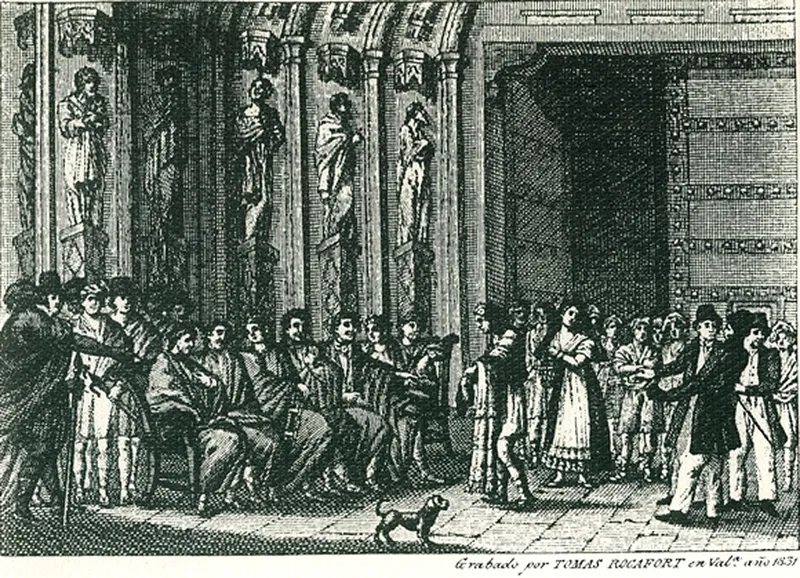
Engraving by Tomás Rocafort
This engraving illustrates the work “Treatise on the Distribution of the Waters of the Turia River and the Tribunal of the Acequieros of the Huerta de Valencia,” by the Valencian jurist Francisco Javier Borrull y Vilanova, published in Valencia in 1831 and printed by Benito Monfort.
The engraving appears at the head of the chapter titled “Of the Tribunal de las Acequias, of the boundaries that compose it, its jurisdiction, its brief yet important procedure for maintaining agriculture in good condition, and the Prince who established it.”
This engraving, with hardly any modification, served as a model for the painter Bernardo Ferrandis for his well-known painting “The Water Tribunal in Valencia,” which is located in the Museum of Fine Arts of Bordeaux, and of which there is a famous replica in the Provincial Council of Valencia.
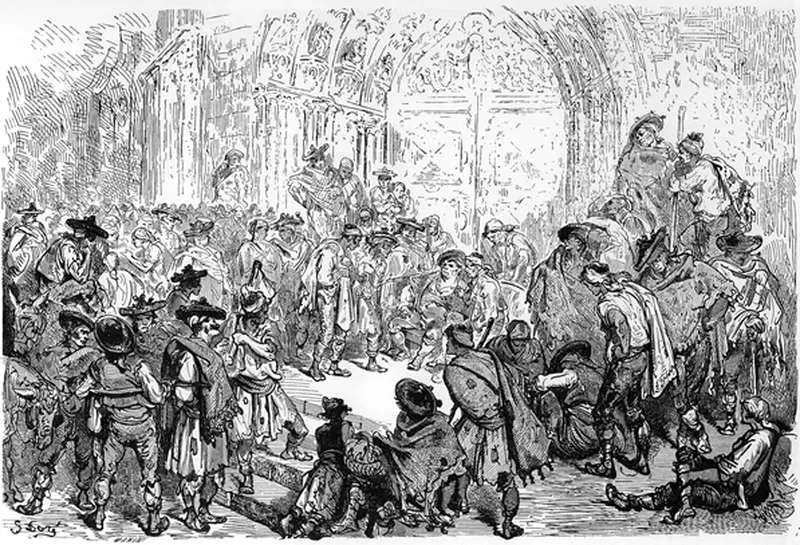
Drawing by Gustave Doré
This well-known illustration by the artist Gustave Doré appears in the magazine Le Tour du Monde. Nouveau journal des voyages, published under the direction of Éduard Charton, and in this case, it illustrates the texts from the journey of Baron Davilliers, who tells us about the origin of the Water Tribunal, the fertility of the Valencian lands, and the importance of irrigation, recounting his experience:
“We did not want to miss the hearing, and before noon we were in the front row, mingled with the crowd of farmers. The judges, representing the “acequias” of the “huerta,” took their seats and sat on a simple sofa upholstered in Utrecht velvet, belonging to the cathedral chapter, which is obliged to provide the seating… this constitutes all the furniture of the tribunal: a table would be useless, as the use of paper, pens, and ink is unnecessary for these authentically biblical judges who reminded us of King Saint Louis dispensing justice under the oak tree in the forest of Vincennes.”
Doré captures in his images the rich color and bustle of a scene that is repeated every Thursday before the Apostles’ Gate of Valencia Cathedral: market gardeners, simple passers-by, curious onlookers… and who, then as now, surround the tribunal in its deliberations and judgments.
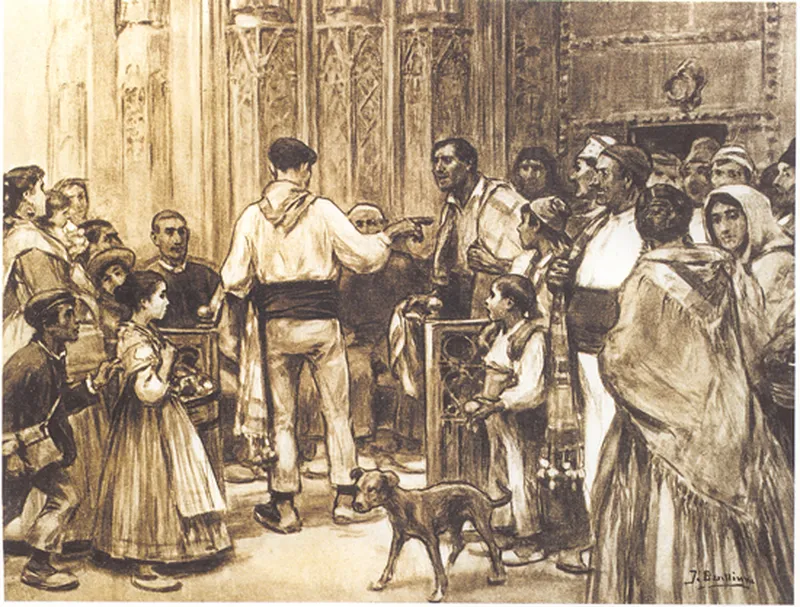
The Tribunal, by José Benlliure
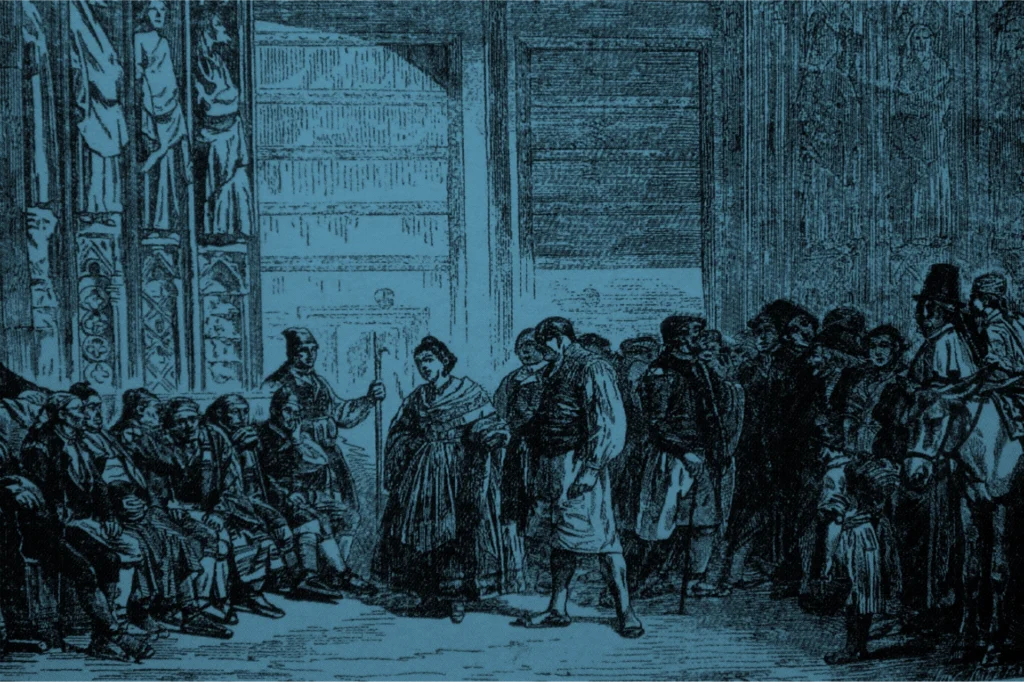
Illustration created by the painter José Benlliure for the luxurious edition of Vicente Blasco Ibáñez’s work “La Barraca” published by Editorial Prometeo.
Once again, popular figures—market gardeners, simple passers-by, the stray dog that also appeared in Tomás Rocafort’s engraving—surround the syndics and the accused of the legendary Tribunal, situated within its gate at the Apostles’ Door. The similarities with Rocafort’s engraving and Ferrándiz’s painting are evident.
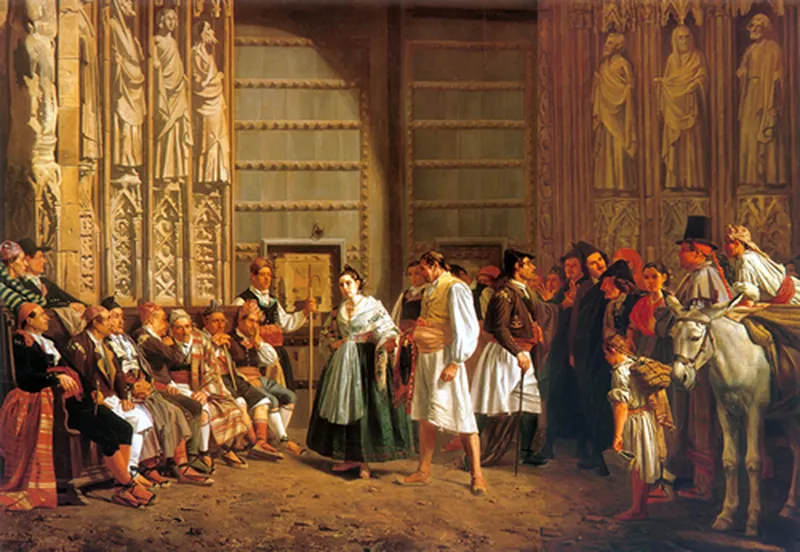
The Tribunal, by Bernardo Ferrandis
It is, without a doubt, the most universal image of the Water Tribunal. Bernardo Ferrándiz, one of the pioneers of costumbrista painting with Valencian themes, began an artistic career in Paris in 1860 that made him the most famous active Spanish painter before the arrival of Fortuny.
After having won the second medal at the 1862 National Exhibition in Madrid with his work “Las Primicias,” and having received a scholarship from the Provincial Council of Valencia that allowed him to further his training abroad, he proposed to paint “The Water Tribunal in Valencia” during his stay in Paris. This work would be supervised by the French Academy professor Ms. Duret for the duration of his scholarship. Thus, the work began in Paris in 1863 and was completed during a several-month stay in Valencia to take notes from life.
However, within a year, the painting’s title would be changed to “The Water Tribunal in Valencia in 1800,” transforming it from a costumbrista painting into a historical one. The reasons for this can be found in the author’s desire to present his work at the 1864 Universal Exhibition of Fine Arts in Paris, as, following Professor Duret’s advice, he believed that historical-themed works had a much greater chance of success at such exhibitions. The author did not achieve the medal he expected; however, in compensation, the director of the French Administration of Fine Arts contacted the author requesting the purchase of the painting by the Minister of the Emperor’s Household and Fine Arts, valuing it at 6,000 francs. This is why it is among the collections of the Museum of Fine Arts of Bordeaux, being, according to C. Reynero (cf. “Los pintores valencianos del siglo XIX entre Roma y París,” in Maestros de la pintura valenciana en el Museo del Prado. Madrid-Valencia, 1997), the first occasion on which a work by a painter born south of the Pyrenees was acquired by the French to be exhibited in a museum. Having been acquired by the government of Napoleon III, as compensation, in 1865, Ferrándiz felt obliged to create a replica of it to deliver to the Provincial Council of Valencia, which had financed his studies; the local press echoed this (La Opinión on September 3, 1865, noted how “Mr. Ferrándiz is finishing a remarkable repetition of the painting The Water Tribunal, a work destined to adorn one of the end walls of the new meeting room of the Provincial Council”).
The Water Tribunal is an essential work due to its emblematic character, as it reflects a deeply rooted reality in Valencian history, and at the time it was painted, it came to symbolize the lost regional liberties. The meticulous details of the work, including the attire, constitute a rich source of information about the life of 19th-century Valencians, which B. Ferrándiz knew well; even among the characters, some of them were close to the painter; his father embodies the president of the Tribunal, and some of his professors from the San Carlos Academy are portrayed as its syndics.
Recently, in 2004, the Robella Acequia was able to confirm that the syndic appearing in the painting seated third (counting from the left) is Don Salvador Aleixandre Tarrasa, who was then the syndic of said Acequia, which casts doubt on the previous opinion expressed in the extensive study carried out by C. Gracia (El Tribunal de las Aguas. Ferrándiz ante la Modernidad. Valencia, 1986).