Symbols
The Hook
The hook, emblem of the thousand-year-old Water Tribunal and faithful witness to its deliberations throughout the centuries. This is how it was seen by Gustave Doré, Tomás Rocafort, José Benlliure, Ferrándiz, and all those who left in their graphic work the testimony of this beloved Institution, the pride of all Valencians, considered a model legal institution of world renown.
This rudimentary and ancestral instrument, always present in the life of the agricultural peoples of the Mediterranean, was of great utility in their daily tasks. Despite its offensive appearance, its improper harpoon shape that suggests attack or defense, its purposes could not be more peaceful since, to solve problems and settle disputes, there was the Tribunal which, impartial and final, deliberated and passed sentence every Thursday, at twelve o’clock sharp, at the Apostles’ Gate of Valencia Cathedral, the public setting for its proceedings.
The hook was, therefore, and remains, the daily working tool of the irrigation ditch guards. Its primary utility is to lift the gates of the dividers so that the water flows through the ditch in search of the fields it is to irrigate (although currently, in many ditches, the way of working has been modernized and this tool is no longer used). On the other hand, the hook is shown to be the most effective instrument for clearing blockages and freeing the ditches of obstacles. Its tip, like an improvised harpoon, helps to capture the board that escapes the guard downstream.
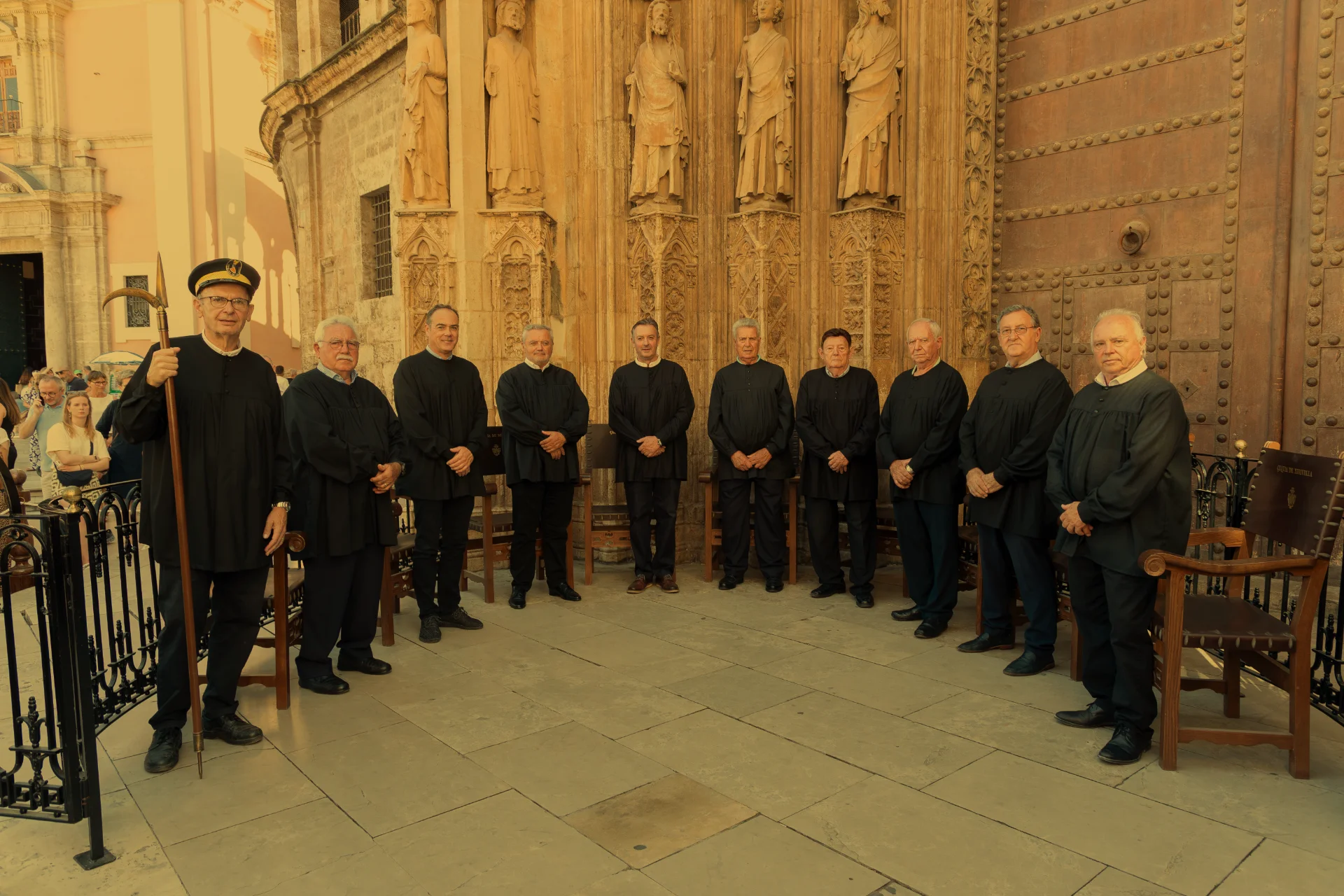
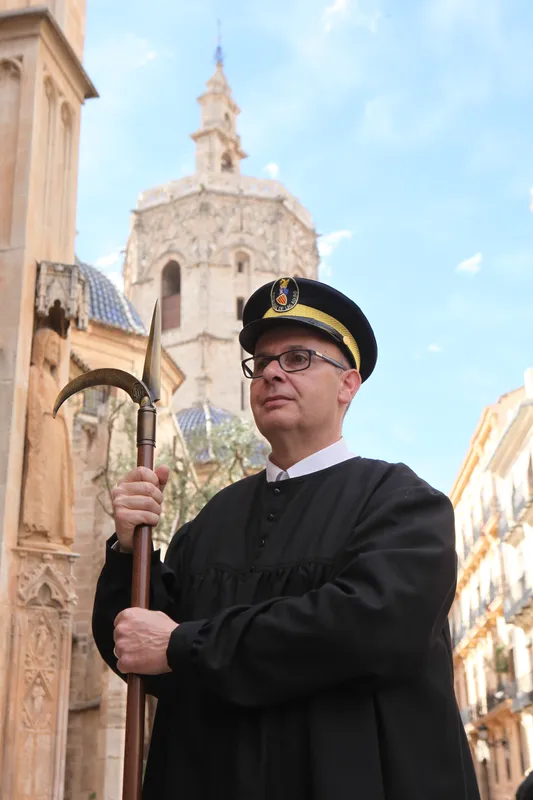
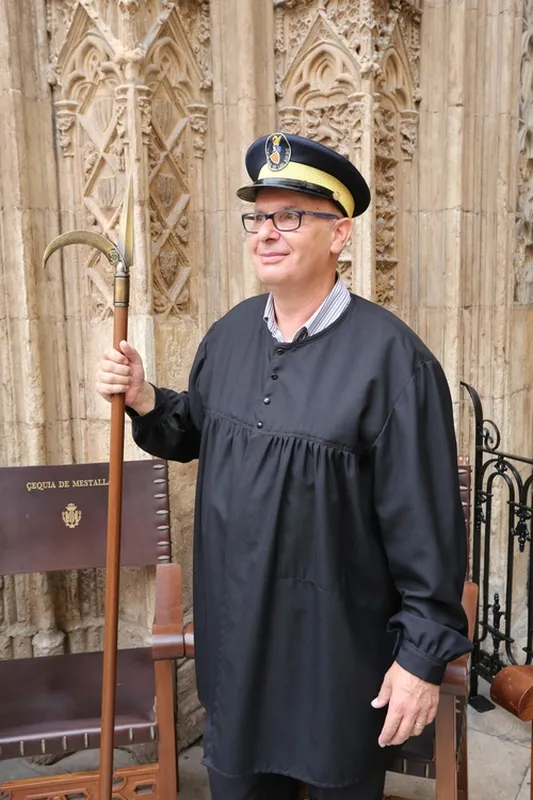
The bailiff, its bearer in official acts and every Thursday during the deliberations of the Water Tribunal, grave and solemn, wearing his traditional orchardman's blouse, begins the sessions by calling from the gate, hook in hand, with the well-known summons: “¡Denunciats de la séquia de Quart!”. And so on, successively.
The Fountain in the Plaza de la Virgen
The origin of this fountain in the Plaza de la Virgen of our city dates back to the 1940s. Indeed, in January 1944, on some steps, the basin of a fountain was installed to be dedicated to Canon Liñán for his prominent role in bringing drinking water to the city.
However, the works remained paralyzed until the last renovation of the Plaza de la Virgen was carried out. Later, the project was replaced by another that placed a large fountain closer to Navellos Street, leaving a more open space for the large celebrations that usually take place in this square.
In this fountain, the Turia River is represented personified as a reclining giant, bearer of the horn of plenty, or Amalthea, as a symbol of the wealth that its waters represent for the fertile plain of Valencia. Around him, on pedestals, eight female figures of naked adolescents, each carrying water pitchers that pour into the fountain’s basin, represent the eight irrigation ditches of the Plain of Valencia.
The figure of Father Turia has classical evocations and recalls the figures of antiquity that personify the Nile, the Tiber, or Bernini’s beautiful Baroque fountain dedicated to the Four Rivers located in the center of Rome’s Piazza Navona. The figures were the work of Manuel Silvestre Montesinos, Silvestre de Edeta. It was inaugurated in 1976.


