Operation
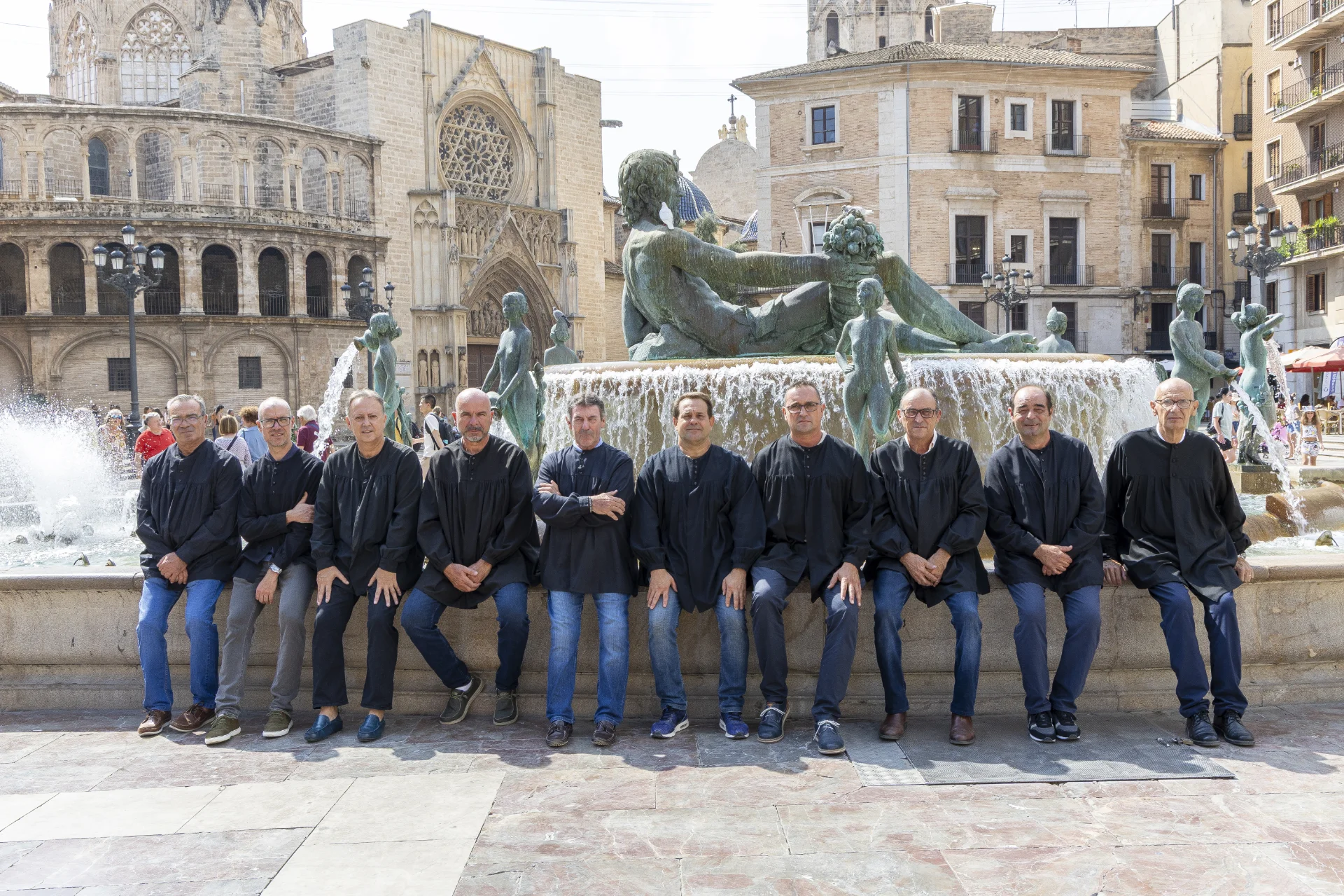
To witness the operation of this court, one simply needs to attend the Door of the Apostles at the Cathedral on a Thursday at 12:00 PM. The process is remarkably simple. The accused person is summoned by the Guard of that irrigation canal to attend the court the following Thursday. The accused may be summoned up to three times. If they do not appear after the complaint has been admitted, they are tried in absentia and may be convicted. This has never been necessary.
The syndics of the eight irrigation canals sit in the chairs assigned to each of their respective canals. The Court Bailiff opens the session. He carries as an insignia an unusual gilded brass harpoon with two prongs, one of which is curved, which was the instrument used to separate and collect the boards from the slots of the water dividers. The Bailiff is the one who requests permission from the President to begin the summons and publicly calls the accused (if any).
The famous “Denunciats de la séquia de Quart!” is heard, followed successively and twice for each canal. If there are accused parties, they appear accompanied by the canal guard. The summons are made in the order in which the canals take water from the river; therefore, they begin with Quart and end with Robella, the last one.
How is a trial conducted?
It is the guard who presents the case or introduces the plaintiff if there is a private accuser. It concludes with the ritual phrase: “Es quant tenia que dir” (That is all I had to say). The President inquires: “qué té que dir l’acusat?” (what does the accused have to say?), and the accused proceeds to defend themselves. The celebrated “calle vosté i parle vosté” (be silent and speak) has fallen into disuse, as has the ancient custom of Arabic tradition of pointing with the foot to the person being granted the floor.
The proceedings of the Water Court are entirely oral, and the trial is conducted entirely in the Valencian language. Everyone intervenes in their own name, without lawyers or written documents; they may propose witnesses and even an on-site inspection (the ‘visura’). The President and members of the Court may ask necessary questions for better information on the case and, without further formality and in the presence of the interested parties, the Court deliberates and passes judgment. To guarantee impartiality, the Syndic of the canal to which the litigants belong does not participate in the deliberation; it is also a rule that if the accused belongs to a canal on the right bank of the river, the sentence is proposed by the syndics of the canals on the left bank, or vice versa. If the sentence is a conviction, the President delivers it with the ritual phrase: “Este Tribunal li condena a pena i costes, danys i perjuins, en arreglo a Ordenances” (This Court condemns you to penalty and costs, damages and losses, in accordance with the Ordinances). The Ordinances of the respective canals establish the penalties for various infractions.
Thus, there are no appeals or recourse, as the sentence is executive in itself. The Court only recognizes and sentences whether the accused is guilty or innocent. The Syndic of the canal is responsible for its execution. In this simple and straightforward way, yet so effective and respected by all members of an agricultural community, the industrious Valencian people have solved their water problems since the most remote times. There are no lawyers, no documents, and no lengthy bureaucratic procedures that delay what constitutes the most elementary of human rights: justice.
And if you wonder what the most frequent reasons for complaints are… there are various types: water theft in times of scarcity, breaking of channels or walls, ‘sorregar’ by discharging water into neighboring fields that damages the harvest due to excess, altering irrigation turns by taking water on a day that is not appropriate, having dirty canals that prevent water from circulating regularly, lifting the ‘parada’ when an irrigator is using their turn, irrigating without requesting a turn, and so on.
For this reason, canal employees can be judged for these types of practices, both in their capacity as irrigators and for their actions before other Irrigation Communities. Even the syndics themselves, as previously mentioned.
Jurisdiction also extends to persons outside the irrigation communities who have caused damage to the irrigation system, as their actions have brought them by their own decision into the sphere of the Court’s competence. In case of non-appearance, they can still be convicted, and one can later resort to ordinary proceedings by filing the corresponding civil lawsuit for damages caused, citing the Water Court’s conviction among the evidence.
The trial proceedings, as already stated, are entirely oral. However, after the first Water Law, the need to maintain a certain record led to a Registry Book containing a few details of each trial, such as: the canal where the event occurred, the names of the accused and the complainant, the reason for the complaint, the verdict, and the date.
The Court has a dual function: judicial and administrative. By custom, the name Tribunal de los Acequieros de la Vega de Valencia is used to refer to these two functions together, while the name Tribunal de las Aguas is reserved for the judicial functions proper. In reality, they are two distinct bodies that act on the same day, place, and time, and are composed of the same people (the syndic is simultaneously a juror and an ‘acequiero’) or with a slight variation: the Robella Canal has a Syndic-juror and a Syndic-acequiero, and the Chirivella Canal does not have a Syndic-juror. When the cases reported at the Door of the Apostles have been judged, the syndics move to the neighboring Casa-Vestuario to discuss common matters; in this case, there are nine syndics as the representative of Chirivella joins them.
The fundamental problem to be addressed is the situation of the river water; depending on the flow, it is decided to open the canal gates more or less and, if appropriate, to request water from the Moncada canal (the ancient Royal or Puzol canal), invoking ancient privileges granted by King James II in 1321. In this administrative aspect, the Court is subject to the Water Commissioner, as a superior entity, who must resolve issues raised between the Water Court and the Chief Acequiero of Moncada. Currently, the main topic of the meetings is related to the release of water from the Benagéber Reservoir. The jurisdictional function is the exclusive competence of the Court; in its administrative function, it is assisted by the lawyers of all the communities, who advise on ordinances, intervene before ordinary jurisdiction, file appeals in defense of the Huerta, etc.


